
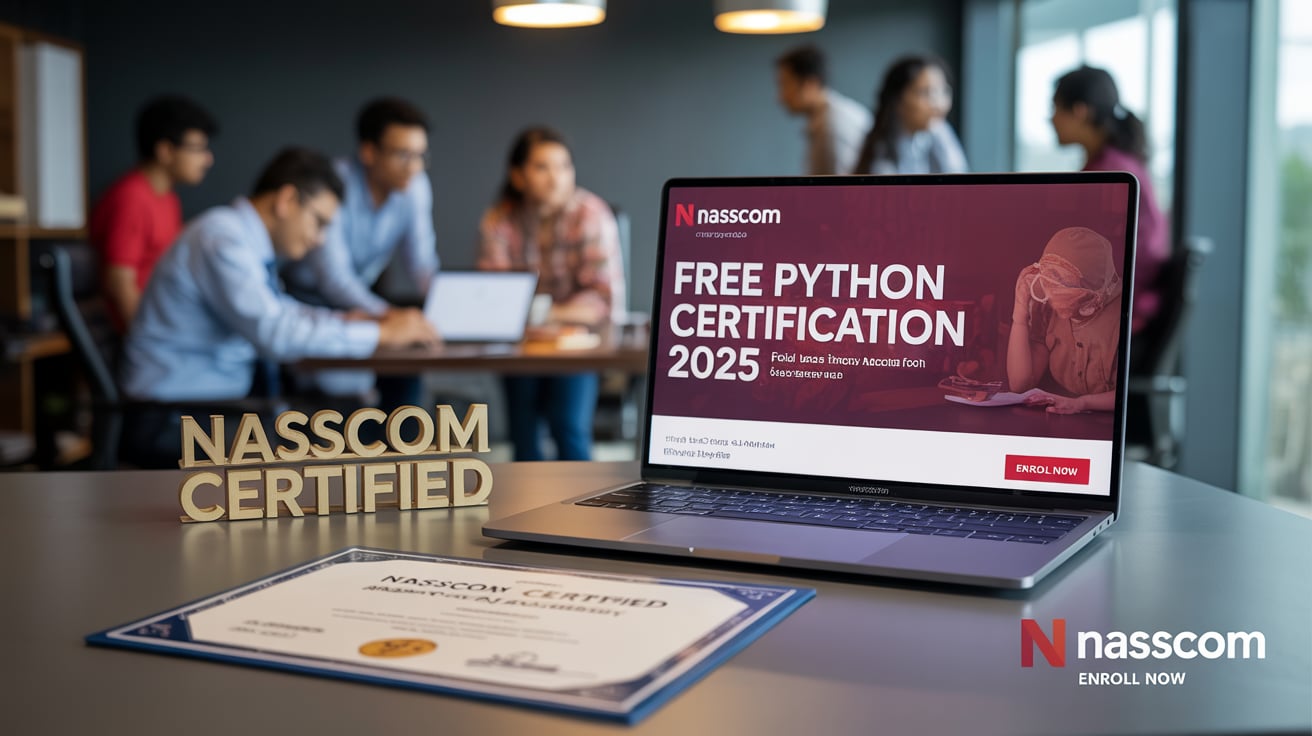
Python is the most in-demand programming language for software development, data science, artificial intelligence, and automation in 2025. To support career starters in India and abroad, Nasscom (the National Association of Software and Service Companies) offers a Free Python Certification Course. This guide provides everything you need to know: course benefits, syllabus, enrollment steps, eligibility, skills gained, career prospects, and SEO focus keywords. Whether you’re a college student, job seeker, or career switcher, Nasscom’s Free Python Certification Course is your gateway to a thriving IT future.
Also Read :- Cisco Launched Free AI Certification Course For Everyone Apply Now 2025
Also Read :- Free Online UI / UX Course for Beginners With Certificate Enroll Now 2025
Table of Contents
About the Free Python Certification Course
The Nasscom Free Python Certification Course is specifically created for freshers and beginners, aiming to bridge the skill gap in the IT industry by making high-quality Python training accessible to all—regardless of technical background or location. The course is structured for absolute beginners and covers both foundational and intermediate Python concepts, culminating in a recognized certificate upon successful completion.
Free Python Certification Course Highlights
A Full Stack Python course covers both frontend and backend development. Key highlights include:
Frontend Development:Learn HTML, CSS, JavaScript, and frameworks like React.js for building dynamic user interfaces.
Backend Development:Master Java with Spring Boot and Python with Flask/Django to create RESTful APIs and backend logic.
Database Management:Work with relational databases (MySQL, PostgreSQL) and ORM tools like Hibernate and SQLAlchemy.
Security and Authentication:Implement authentication mechanisms (JWT, OAuth) and secure your applications.
Deployment:Learn DevOps practices, version control with Git, and deploy applications on platforms like AWS or Heroku.
Testing:Gain skills in unit and integration testing for both frontend and backend.
What will you learn in Fullstack Python course?
Develop proficiency in frontend technologies like HTML, CSS, JavaScript, and React.js for creating dynamic user interfaces.
Build robust backend applications using Java (Spring Boot) and Python (Flask/Django), including RESTful API development.
Gain expertise in database management, working with SQL, and using ORM frameworks like Hibernate and SQLAlchemy.
Implement authentication, security best practices, and handle real-time communication with WebSockets.
Master deployment, version control with Git, and DevOps practices to deploy full-stack applications to cloud platforms.
Why should you take Fullstack Python course?
High Demand:Full-stack developers are highly sought after for their ability to manage both frontend and backend technologies.
Versatility:Mastering both Java and Python makes you adaptable to a wide range of projects and industries.
Career Growth:Full-stack skills open doors to higher-paying roles and leadership opportunities in tech.
Efficiency:Knowing both frontend and backend development allows you to build end-to-end applications independently.
Job Flexibility:Gain the ability to work on both small startups and large enterprise-level applications with diverse tech stacks.
Who should take Fullstack Python course?
Aspiring developers who want to become proficient in both frontend and backend technologies.
Professionals seeking to expand their skill set and transition into full-stack development.
Software engineers looking to enhance their career opportunities by Python
Curriculum for Free Python Certification Course
1. Introduction to Full Stack Development
Overview of Full Stack Development
Understanding frontend, backend, and database integration
Tools and technologies used in Full Stack Development
2. Frontend Development
HTML:Structure of web pages, forms, links, and media elements
CSS:Styling, layouts, and responsive design principles
PythonScript:Basics of JS, DOM manipulation, and event handling
React.js:Building dynamic user interfaces, components, state, and props
UI/UX Design:Basic principles for creating user-friendly interfaces
3. Backend Development (Python)
Python Basics:Object-oriented programming, syntax, and core libraries
Spring Boot:Creating RESTful APIs with Spring Boot, dependency injection, and configuration
Spring Security:Implementing authentication and authorization
Spring Data JPA:Database integration and managing data with ORM
Unit Testing:Using JUnit for testing Python applications
4. Backend Development (Python)
Python Basics:Syntax, functions, loops, and modules
Flask/Django:Setting up backend frameworks, building APIs, and routing
Database Integration:Working with SQL databases using SQLAlchemy (Flask) or Django ORM
Authentication and Authorization:Implementing user login systems
Unit Testing:Writing tests using pytest
5. Database Management
SQL Basics:Database creation, CRUD operations, and relational design
Relational Databases:Working with MySQL, PostgreSQL, and SQLite
Database Design:Normalization, indexing, and foreign keys
ORM Integration:Using Hibernate (Python) and SQLAlchemy (Python) for database interaction
6. RESTful API Development
API Design:Best practices for designing RESTful APIs
API Documentation:Using Swagger for API documentation
Connecting Frontend to Backend:Fetching data using fetch API or Axios
7. Authentication and Security
JWT (JSON Web Tokens):Implementing token-based authentication
OAuth:Understanding and implementing OAuth for authorization
Security Best Practices:Data validation, input sanitization, and preventing common vulnerabilities (XSS, CSRF)
8. Deployment and DevOps
Version Control with Git:Basics of Git and GitHub for code management
CI/CD Pipelines:Setting up Jenkins or GitHub Actions for continuous integration and deployment
Docker:Containerization for easy deployment
Cloud Platforms:Deploying applications to AWS, Heroku, or similar platforms
9. Testing and Debugging
Frontend Testing:Unit testing in PythonScript using Jest
Backend Testing:Writing and running tests for Python and Python applications
Debugging:Techniques and tools for debugging code across the stack
10. Capstone Project
End-to-End Application:Build a complete full stack project integrating frontend, backend, and database
Project Deployment:Deploy your application to a cloud platform and share it with potential employers or clients
This curriculum provides a comprehensive learning path for becoming a skilled full stack developer using Python.
Tools you will learn in Free Python Certification Course
- For a Fullstack Developer with Java and Python, key skills include proficiency in frontend technologies like HTML, CSS, JavaScript (React.js/Angular), and backend frameworks (Spring Boot for Java, Django/Flask for Python). Essential tools are Git for version control, Docker for containerization, and cloud platforms (AWS, Google Cloud). Familiarity with databases (MySQL, PostgreSQL, MongoDB) and API development (RESTful services, GraphQL) is crucial. Understanding CI/CD, DevOps tools (Jenkins, Kubernetes), and testing frameworks (JUnit, pytest) ensures smooth deployment and maintenance. Security knowledge, including OAuth and JWT, is vital for robust applications.
Benefits of the Free Python Certificate
Boosts Employability: Adds a credible skill to your portfolio.
Recognized by Industry: Nasscom is the leading IT industry body in India; their certification enhances your CV.
Supports Career Switchers: Non-tech professionals can leap into Python roles easily.
Builds Confidence: Real project work demonstrates your skills to employers.
How to Apply?
If you are an Interested Candidate, You can apply For Nasscom Free Python Certification Course For fresher Get Free Certificate Enroll Now 2025 Click Here
Conclusion
Python is the language of the future—and with Nasscom’s support, your learning is risk-free, flexible, and credible. The 2025 Nasscom Free Python Certification Course for Freshers enables anyone, from any academic or professional background, to acquire industry-relevant programming skills at no cost.
FAQ’s
Is Nasscom’s Free Python Course for 2025 really free?
Absolutely! Eligible learners can enroll, complete the course, and earn the certificate at zero cost, thanks to government and Nasscom initiatives.
Who can enroll for this course?
Any student, fresher, graduate, or professional—no coding experience required.
How long does the course take?
The core course is usually 20-30 hours for beginners, with flexible deadlines.