
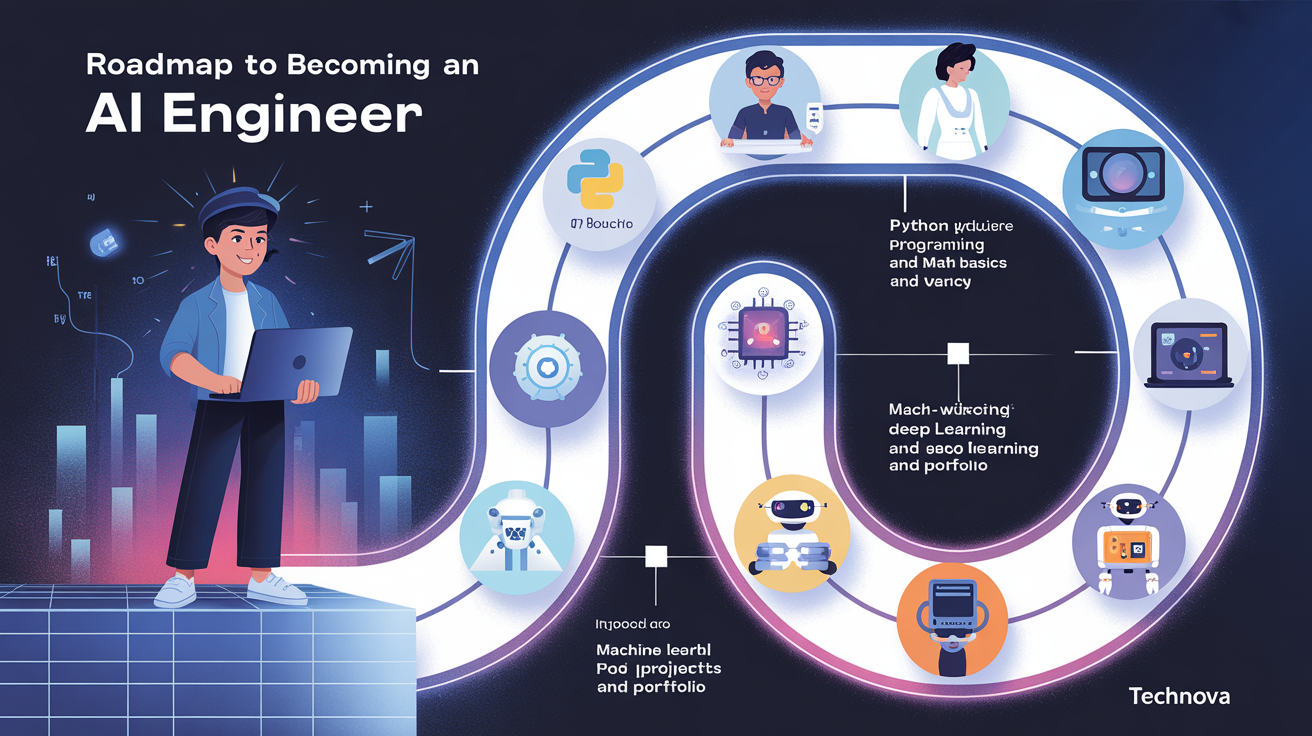
Artificial Intelligence (AI) is transforming every industry, from healthcare and finance to entertainment and manufacturing. As companies accelerate their adoption of AI-driven solutions, the demand for skilled AI Engineers is skyrocketing. For graduate students in 2025, pursuing a career as an AI Engineer offers the opportunity to work on cutting-edge technologies, solve real-world problems, and enjoy lucrative career prospects.
Also Read :- How to Crack Google Summer of Code 2026 | Complete Roadmap & Strategy
Also Read :- Web Development Complete Roadmap for Students, Freshers & Jobseeker in 2025
Table of Contents
Who is AI Engineer?
An AI Engineer is someone who builds smart computer systems that can learn, solve problems, and make decisions—just like humans do. These professionals use a mix of computer programming, math, and data to create machines and software that can recognize images, understand speech, translate languages, and even recommend what you might want to watch or buy next.
What does an AI Engineer do?
AI engineers turn ideas and AI innovations into real-world solutions. They take business challenges and problems and develop AI systems to address them. Responsibilities vary across industries and organizations but often include:
- Creates Smart Programs: Designs and develops systems that can learn from data, spot patterns, and improve over time.
- Works With Data: Collects and prepares huge amounts of information so computers can learn from it.
- Builds and Tests Models: Uses tools and frameworks to train computers to do tasks like recognizing faces in photos or understanding text.
- Deploys Solutions: Makes sure these smart systems work in real-world apps—like chatbots, recommendation engines, or self-driving cars.
- Collaborates: Works with other engineers, data scientists, and business teams to solve real problems using AI.
AI Engineer Roadmap 2025: Month-by-Month Breakdown
Top Skills Required for AI Engineers in 2025
1. Programming (Python, R, Java)
2. Mathematics (Linear Algebra, Calculus, Probability)
3. Machine Learning Algorithms
4. Deep Learning (CNN, RNN, LSTM)
5. Natural Language Processing (NLP)
6. Big Data Technologies (Spark, Hadoop)
7. Cloud Computing (AWS, GCP, Azure)
8. MLOps & Model Deployment
9. Prompt Engineering for LLMs
10. Data Visualization (Matplotlib, Seaborn)
11. Version Control (Git/GitHub)
12. AI Ethics and Responsible AI
13. Communication and Collaboration
Artificial Intelligence (AI) Engineer Complete Roadmap for Graduate Students in 2025
Why Choose AI Engineering in 2025?
AI is everywhere—healthcare, finance, entertainment, and even daily apps. Companies want smart solutions, so the demand for skilled AI engineers is booming. If you’re a graduate student, now is the perfect time to start your AI journey and build a future-proof career.
Step 1: Build a Strong Foundation
Programming Skills:
Start with Python—it’s the most popular language in AI. Learn the basics: variables, loops, functions, and object-oriented programming. Knowing R, Java, or C++ is a bonus, but Python is a must.
Mathematics:
Brush up on linear algebra (vectors, matrices), calculus (derivatives, gradients), probability, and statistics. These are the backbone of machine learning and deep learning.
Step 2: Master Data Structures and Algorithms
Understand how to use arrays, linked lists, trees, graphs, hash tables, and algorithms for searching and sorting. Practice coding problems on platforms like LeetCode or HackerRank. This will help you write efficient code and ace interviews.
Step 3: Learn Data Handling
Get comfortable with data manipulation using NumPy and Pandas. Learn how to clean, preprocess, and visualize data. Mastering SQL for databases is also important, as you’ll often work with large datasets.
Step 4: Dive into Machine Learning
Core ML Concepts:
- Supervised & Unsupervised Learning
- Regression, Classification, Clustering
- Model evaluation metrics (accuracy, precision, recall, F1-score)
- Feature engineering and selection
Tools:
- scikit-learn
- Jupyter Notebook
- Google Colab
Step 5: Explore Deep Learning
Key Areas:
- Neural Networks (NN)
- Convolutional Neural Networks (CNN) for images
- Recurrent Neural Networks (RNN) and LSTM for sequences
- Transformers for advanced NLP tasks
Frameworks:
Step 6: Specialize Further
Pick an area to specialize in based on your interest:
- Natural Language Processing (NLP): Chatbots, language models
- Computer Vision: Image and video analysis
- Generative AI: GANs, LLMs
- Reinforcement Learning: Robotics, game AI
Step 7: Understand MLOps and Deployment
Learn how to deploy models into real-world applications:
- Docker and Kubernetes for containerization
- Flask or FastAPI for building APIs
- Cloud platforms (AWS, GCP, Azure) for scalable deployment
- MLflow for model tracking and versioning
Step 8: Work on Real Projects
Apply your skills to real-world problems:
- Build projects like recommendation engines, image classifiers, chatbots, or fraud detection systems.
- Participate in Kaggle competitions or contribute to open-source AI projects.
- Showcase your work on GitHub and create a portfolio website.
Step 9: Learn Prompt Engineering and LLMs
2025 is the year of Large Language Models (LLMs) and prompt engineering. Learn how to design effective prompts for models like GPT-4, Gemini, or open-source LLMs. Explore Retrieval-Augmented Generation (RAG) for combining LLMs with external knowledge.
Step 10: Stay Updated and Network
- Follow AI news, research papers, and online communities.
- Join AI meetups, webinars, and conferences.
- Connect with mentors and peers on LinkedIn or Discord.
Step 11: Get Certified
Certifications can boost your profile:
- Google TensorFlow Developer Certificate
- Microsoft Azure AI Engineer
- Coursera, Udemy, or OpenCV University AI programs
Step 12: Focus on Soft Skills and Ethics
- Communication: Explain technical concepts simply.
- Teamwork: Collaborate with engineers, data scientists, and business teams.
- Ethics: Understand AI fairness, bias, and responsible AI practices
Final Tips
- Practice daily: Consistency matters most.
- Build real projects: Theory is important, but hands-on experience is what sets you apart.
- Stay curious: AI is always evolving—never stop learning
Conclusion
Becoming an Artificial Intelligence Engineer in 2025 is a highly rewarding path for graduate students passionate about technology and innovation. By following this complete roadmap—grounded in programming, mathematics, machine learning, deep learning, cloud, and real-world projects—you can build a future-proof career and contribute to the next wave of AI-driven transformation.
Preparation Material to become ai engineer
Enroll in this free ai engeer course, CLICK HERE